
Columbia County Criminal Docket Searches
When the court level is unclear, start with the Washington Courts case search. It covers municipal, district, Superior, and appellate cases. Updates usually land within about 24 hours, though the local court record still controls. A name match by itself proves little. So check the court, case number, filing date, and party role before trusting a result.
Felonies belong to Columbia County Superior Court. Misdemeanors and gross misdemeanors go to Columbia County District Court. Dayton ordinance matters run through that same limited-jurisdiction office. For help, call the County Clerk at 509-382-4321 for Superior matters. District Court takes calls at 509-382-4812. The District records-request form works for inspection or copies by mail, fax, email, or pickup.
- Choose Superior, District, or Dayton Municipal jurisdiction before searching.
- Use the full case number when known, or search a complete party name.
- Filter Columbia County, criminal case type, status, and filing dates.
- Open the case and review Events, Hearings, and Disposition Events.
- Confirm the latest setting or request the exact document from the proper clerk.
Columbia Criminal Cases in Odyssey
For Columbia County Superior criminal cases, the Odyssey Smart Search is the main public route. Enter a record number or search by last and first name. Filters can narrow by location, case type, status, filing window, or judicial officer. Narrow common names, because the interface returns only the first 200 results.
Once a case number is open, work through Case Information, Party, Events, Hearings, and Disposition Events. The chronological view is called the Register of Actions. That register is the working Columbia County criminal docket. A missing image does not mean a filing never happened, though. Anonymous users see public case information. Document access can depend on registration, a role, a county subscription, or the nature of the record. For copies, go through the County Clerk or the Washington State Digital Archives.
Criminal Dockets: What They Show
A Columbia County criminal docket ties identity and court fields to a dated sequence of events. Read it from oldest to newest. The latest valid order or setting deserves the most weight. An entry marked as a motion is only a request, not the ruling itself. In the same way, a charge stays an allegation. The disposition and signed judgment must establish the outcome before anything changes.
| Case header | Case number, filing date, case type, Columbia location, judicial officer, and status. |
|---|---|
| Parties | Defendant, prosecuting authority, attorneys, representation, and any restricted marker. |
| Charges | Offense category, count, level, amendment, plea, and disposition when publicly shown. |
| Events | Appearance, arraignment, motion, plea, sentence, review, dismissal, judgment, or appeal entries. |
| Settings | Date, time, hearing type, judge, courtroom, and sometimes the appearance method. |
| Financials | Costs, fines, legal financial obligations, restitution, or payment-plan events where available. |
Columbia Charges Are Not Convictions
A criminal filing opens a case record. It decides nothing about guilt. Terms like “preliminary appearance,” “initial arraignment,” and “pretrial” all describe stages. Those stages come before final disposition. A guilty plea may lead to sentencing. But the signed judgment is the better source for the precise result. Dismissal, acquittal, deferred action, and other outcomes must be read from the actual event and order.
When a Columbia County docket says “closed,” do not guess why. Look at the last disposition event. Then get the judgment from the keeper of that court’s file. A portal snapshot is handy for tracking, but formal proof calls for a certified judgment. Names repeat, so match the case number and court as well as the name.
Criminal Case Stages on the Docket
Superior and District matters may use different labels. Still, the Columbia County criminal docket tends to follow a recognizable series. A charge or complaint starts the case. An initial appearance or arraignment then covers rights, the charge, plea, custody, and future settings as applicable. Pretrial entries record motions, conferences, and changed dates. From there, a plea or trial can produce a disposition. Sentencing and later review or payment events follow.
Docket flow: Filing › Arraignment › Pretrial › Plea or Trial › Disposition › Sentencing
The Columbia County Superior recurring schedule splits criminal blocks into in-custody and out-of-custody sessions. It also lists a criminal legal-financial-obligation docket. Those labels help explain a setting. They do not confirm that a specific case remains on the day’s call. For that, check the current docket PDF or the Odyssey hearing entry.
Columbia County Criminal Docket Courts
Columbia County Superior Court hears felonies and related major proceedings. The Columbia County Clerk serves as its ex-officio clerk. The clerk keeps the Superior criminal records. The judge works a shared Asotin, Garfield, and Columbia assignment, so the current county calendar matters when a case has moved between settings.
Columbia County District Court handles misdemeanors and gross misdemeanors. Its local page lists maximum penalties of up to 90 days and $1,000 for misdemeanors. Gross misdemeanors run up to one year and $5,000. Dayton Municipal Court covers city ordinance and traffic matters. It is routed through District Court. Juvenile offender matters follow separate statutory access rules, so an adult search route may not reveal the same information.
The official Superior Court source shows the court department and its local access routes:
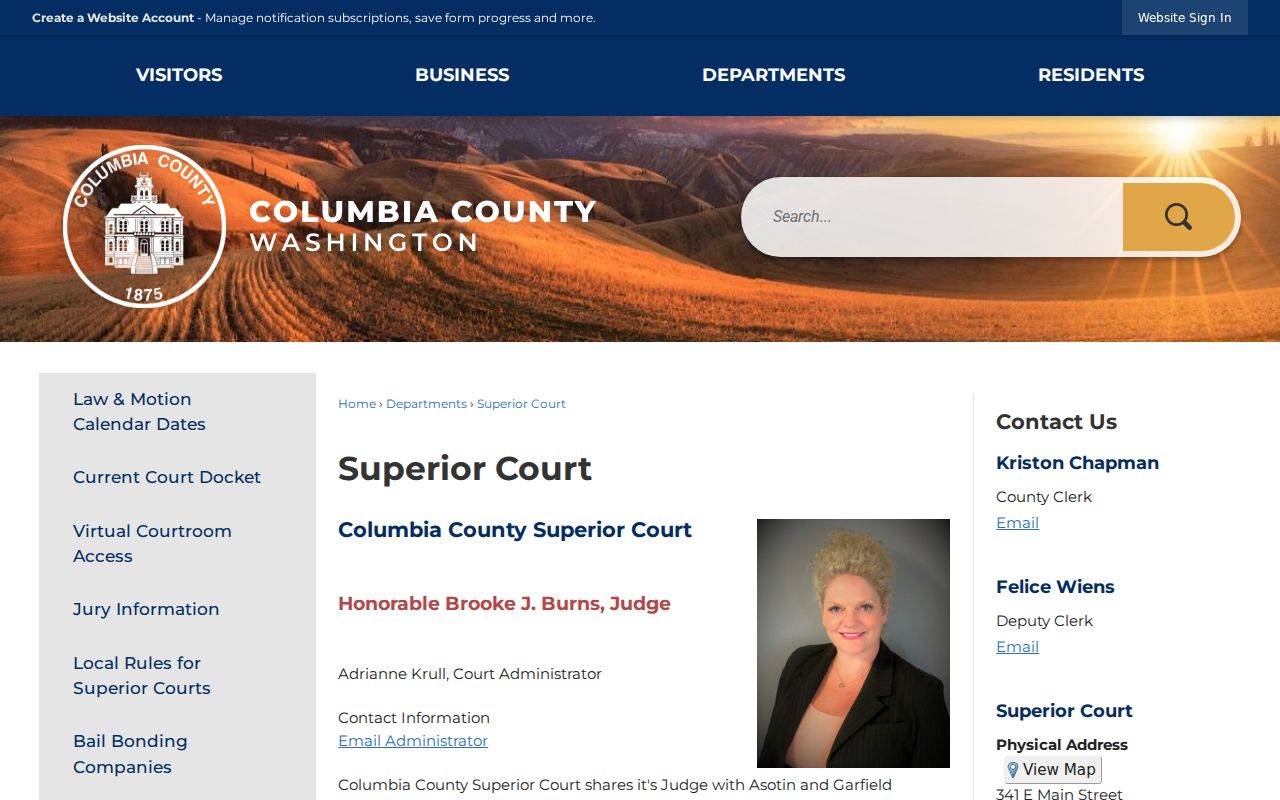
Columbia County splits its court work between two clerks. The Columbia County criminal docket lives with the Prothonotary, so that office verifies entries and supplies any certified record a searcher needs.
Columbia Criminal Docket Counts
Columbia County's Superior Court annual tables for 2025 list 536 criminal proceedings. The breakdown: one trial, 512 nontrial proceedings, and 23 non-charge proceedings. Arraignments, plea hearings, sentence hearings, preliminary appearances, reviews, and post-resolution work all sit inside that nontrial line. Count events, though, not people. The figure is not a tally of separate defendants or cases in the Columbia County criminal docket.
A second table counts charges instead of events. It shows 56 felony counts alongside 32 misdemeanor or gross-misdemeanor counts for Columbia County. Don't expect the totals to line up. Each table measures something different, so mismatches are normal rather than a sign of error.
The felony detail splits into two homicide counts, one sex-crime count, and eight assault counts. Add 21 theft or burglary counts, four motor-vehicle-theft counts, and 20 other felony counts. No controlled-substance count appears in that category. These are resolved offense counts under the annual report's own definitions. Adding them to proceeding counts would double-count. Neither table tells you the status of any individual court docket.
Treat the numbers as scale, nothing more.
Access Rules for Criminal Dockets
Washington General Rule 31 presumes public access to court records. A law, rule, court order, or case law can still restrict a record. Sealing, redaction, and destruction run through General Rule 15. A judge must actually find that privacy or safety interests outweigh the public's access. The parties agreeing among themselves is not enough. Even so, a shell entry for a public event can stay visible after a document is sealed or redacted.
Key access rules:
Washington GR 31 provides the general court-record access framework.
Washington GR 15 sets the findings and process for sealing or redaction.
RCW 13.50.050 governs access to juvenile offender court files and related confidential information.
Courts do not count as agencies under Washington's Public Records Act. The county's public-records page explains this. So the county PRA portal is the wrong door for a Columbia County court docket. Use the County Clerk instead. Options include the District Court form, the courthouse counter, mail, the phone, or an authorized electronic system. If full access is denied, ask the clerk whether a redacted public copy exists.
Missing Columbia Criminal Documents
A dead document link has several possible causes. It may reflect a role limit, a sealed filing, or a restricted case type. Or the filing was never placed in remote access at all. Write down the Columbia County case number, the event date, and the exact item you need. For Superior Court, contact the County Clerk. You can also search the Digital Archives collection, which spans 1985 through 2026 but blocks restricted categories from online ordering.
District and Dayton records run through the District request form. Pick inspection, copies, or whichever service the form lists. Say it is criminal and give the name. Note any date-of-birth or license information available through the official channel. Include the case number, charge or date, the document wanted, certification, and delivery method. Never try to work around portal controls. The clerk can tell you whether a public version exists or a court order is required.
JIS-Link offers another statewide route. It is paid, and it is display-only. Its SCOMIS screens can show a docket chronology, charges, names, sentence, calendar, status, and judgment fields. They never show document images. Archived or offline gaps still happen. JIS-Link helps you identify an event. The Columbia County clerk remains the source for the underlying filing and a certified copy.
Columbia Criminal Calendar Checks
Any posted docket is a snapshot, not a promise. Columbia Superior lists recurring blocks for in-custody criminal matters. Out-of-custody criminal matters get their own blocks, along with juvenile work and legal-financial-obligation reviews. District docket days fall on Tuesdays as scheduled. A later order or hearing entry can replace an older time that still lingers in the event history.
When entries conflict, read the newest Odyssey Hearings and Register of Actions entries first. Then check the current Superior docket page or the District docket-day archive. Call the proper clerk to settle it. The broader Columbia County docket search can help you locate the case first. A recurring block alone never guarantees the court will reach a particular matter that day.