
Columbia County Civil Docket Searches
Pick the court first. Columbia County Superior Court hears the major civil claims. It also takes real-property and title matters, civil protection matters, and administrative review. District Court handles civil damage claims up to $100,000. It never takes title or possession of real property, though. Its small-claims track stops at $5,000 in money claims and cannot order property returned.
Unsure which court holds the case? Begin with the Washington Courts case search, a free statewide index. It is generally refreshed within about 24 hours. The local file remains the complete source, so treat the portal as a pointer. For Superior records, call the Columbia County Clerk at 509-382-4321. District civil and small-claims records go through District Court at 509-382-4812. Its request form covers inspection, copies, certification, and delivery by mail, fax, email, or pickup.
- Identify Superior, District, or small-claims jurisdiction.
- Search by the full civil case number when available.
- For a name search, enter the party or business name and narrow Columbia County.
- Compare the case type, filing date, location, and party role.
- Open Events, Hearings, and Disposition Events, then request needed documents.
Columbia Civil Jurisdiction Limits
The dollar figure does not settle every jurisdiction question. Columbia District Court's published $100,000 civil limit covers damage claims only. Title or possession of real property is excluded. So a dispute asking for a title ruling belongs in Superior Court, even if someone assumes a lower dollar value should place it in District Court.
| Track | Columbia County scope | Key limit |
|---|---|---|
| Superior civil | Major civil, property or title, protection, administrative review | General jurisdiction |
| District civil | Civil damage claims | Up to $100,000; no real-property title or possession |
| Small claims | Money judgment only | Up to $5,000; no return-of-property order |
This court split shapes the search itself. The County Clerk maintains Superior civil records, while District Court administration keeps the District and small-claims files. Ask the wrong office for a filing or a record, and the Columbia County civil docket search slows down.
Civil Dockets: What They Show
A civil docket opens with a case header and party listing. From there it logs each procedural event. Odyssey results can show a case number, file date, type, location, and party name. Click the case and tabs appear. The tabs are Case Information, Party, Events, Hearings, and Disposition Events or the Register of Actions. JIS or SCOMIS may instead use different labels. The views there are Docket, Names, Calendar, Status, Summary, and Find Judgments.
| Case number | Use the full local number, such as the Archives example 12-2-000011-7, without guessing at its parts. |
|---|---|
| Parties | Plaintiff or petitioner, defendant or respondent, attorney, and party role. |
| Filings | Complaint, petition, answer, proof of service, exhibits, and later papers when public. |
| Motions and orders | Requests for relief and the court’s separate rulings. |
| Hearings | Date, time, setting type, judicial officer, courtroom, and appearance details when shown. |
| Outcome | Settlement, default, dismissal, judgment, disposition, and related financial events. |
Columbia Civil Odyssey Tabs
For Columbia County Superior civil case information, use Odyssey Smart Search. A record number works best as the search key. Name searches can split last, first, and middle into separate fields. Advanced Filtering Options narrow the location, search type, case status, file dates, or judicial officer. The official guide permits wildcards after minimum character counts. It also warns that only 200 results appear.
Each tab answers a different question. Party identifies who appears in the matter, and Events tracks filings and court action. Hearings shows settings, while Disposition Events records outcomes. The Register of Actions puts every event in date order. Anonymous access can reveal case information. But a document link may require a registered role or a county-authorized subscription. A missing image means one thing. It calls for a request to the County Clerk or Digital Archives, not a claim that the document never existed.
The Washington State Digital Archives offers a second Superior route for one-time or infrequent orders. Its Columbia collection spans 1985 through 2026. It accepts a case number or keywords with a year range. Files can hold complaints, pleadings, orders, decrees, depositions, verdicts, and awards. The search itself is free. Full files are ordered rather than previewed as instant images.
What Cases Fill the Civil Docket
Columbia County Superior Court's 2025 annual table sorts civil work into official categories. Those labels help when setting a portal filter, but they never replace the case caption or the filed complaint. District civil and small claims sit in a different court, so they may not show up in the same interface as a Superior matter.
- Tort and commercial disputes
- Property-right and title matters
- Civil protection order proceedings
- Administrative-law review
- Other petitions, complaints, and “other matters”
Family, guardianship, probate, adoption, and juvenile matters can feel civil in a broad sense. Washington systems treat them as distinct case categories. Each has special access rules. Search the actual category and its court. Forcing every noncriminal matter into a generic civil filter leads nowhere.
Columbia Civil Filings by Number
The official 2025 Superior annual report counted 87 Columbia County civil filings. The breakdown: 3 tort, 2 commercial, 13 property-rights, 18 civil protection orders, 1 administrative-law review, 13 other petitions or complaints, and 37 other matters. It also reported 63 nontrial civil resolutions and no trial resolutions in that table.
A separate civil case-management report listed 61 active pending cases, a 0.97 resolution ratio, and 14 cases pending more than 24 months. Report rules matter here. "Other matters" and suspended cases both affect the measures. No figure in the set names a private party or decides the current status of a particular docket.
The official civil report display shows the local context behind those Columbia County civil docket counts.
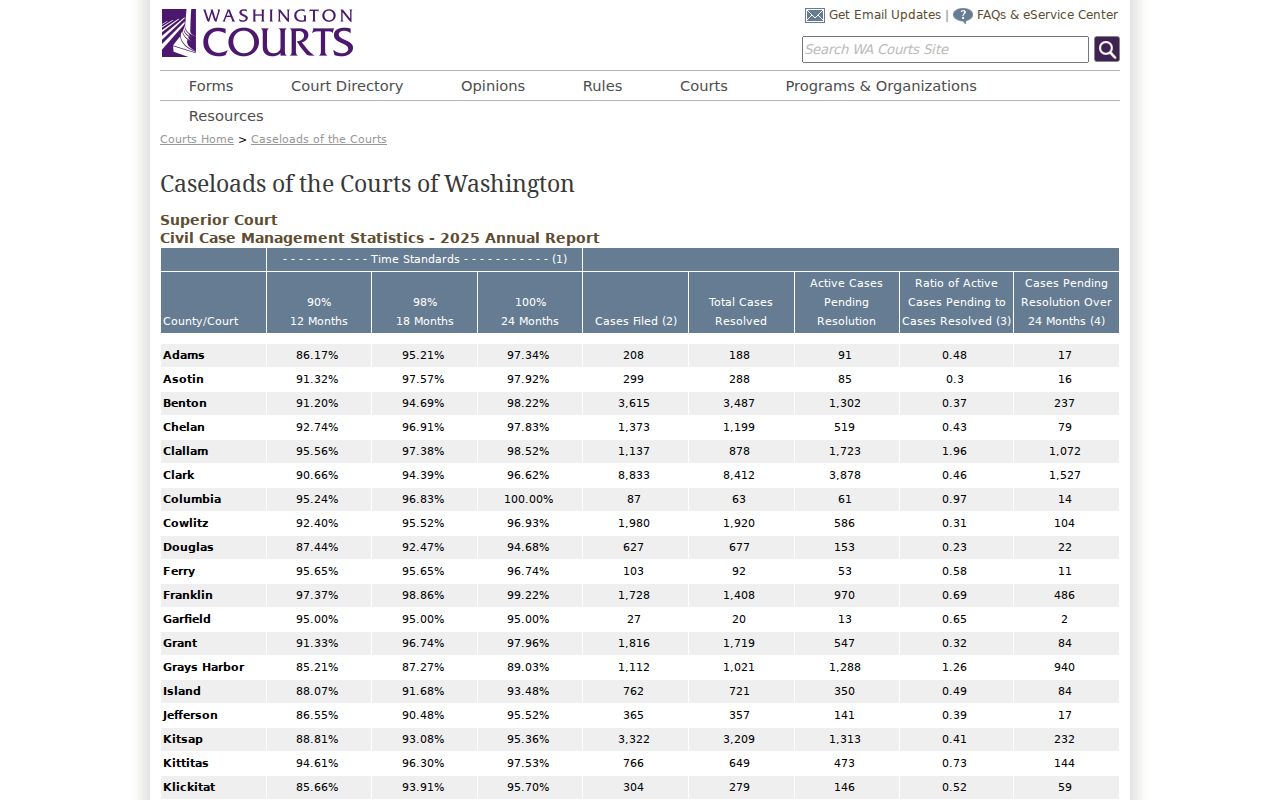
Statistics never replace the live register or a clerk-certified case document. Use them for context, not for answers about one docket.
Hearings on the Civil Docket
Columbia Superior Court keeps a standing civil block at 11:15 a.m. on its law and motion calendar. That is a category, not a promise. A named case may or may not land there. Before you count on a time, check Odyssey Search Hearings and the case's Register of Actions for the current setting, then compare it against the county's current docket page.
One more wrinkle matters. A new setting can replace an old one while both sit in the event history. Watch for words like continued, reset, passed, canceled, or stricken, and read forward to the latest docket entry. If two records conflict, call the County Clerk. The Columbia County court schedule walks through the county calendar, the current docket PDF, and the limited-jurisdiction date routes in more detail.
Columbia Complaints Are Not Judgments
A Columbia County complaint or petition only states a claim. It is not a decision. A motion works the same way. It asks for action but does not prove the judge granted anything. Even an open or closed status tells you little. You still need the disposition event and the signed order or judgment when it matters.
Need formal proof? For a property, title, or judgment matter, ask the Columbia County Clerk for a certified copy. Skip the screen print. District requesters can mark the certification choice on the local record form. List the court, the case number, and the party role. Add the exact order or judgment you need, the certification you want, and how it should be delivered. That line keeps routine docket tracking apart from proof a court will actually stand behind.
Who Can See Civil Dockets
Access to these court records is broad but not absolute. Washington General Rule 31 opens court records to the public. It is subject to law, rule, order, and case law. General Rule 15 governs sealing and redaction. General Rule 22 adds special limits for family-law, protection-order, guardianship, and therapeutic records. So a Columbia County civil docket shell can stay searchable. A name, attachment, report, or order can still be withheld from view.
Public access is record-specific.
Washington GR 31 sets the general access framework.
Washington GR 15 requires a legal basis and findings for sealing or redaction.
Washington GR 22 protects specified family, guardianship, protection, and therapeutic material.
Columbia County treats its courts as outside agency status under the Washington Public Records Act. So skip the general county PRA portal. Send court-file requests to the County Clerk or District Court instead. If access is denied, ask a simple question. Which rule or order controls, and can a redacted public copy of the docket record be released?
Columbia District Civil E-Filing
Attorneys must use eFileWA. Columbia District Court's rules effective September 1, 2026 make the filing mandatory through the designated electronic filing and service system. Self-represented filers get encouragement, not a requirement. Electronic filing only changes how a document reaches the court. It does not put every filing in front of every remote user.
Some items still travel on paper. These include original wills, certified appeal records, negotiable instruments, foreign-government documents with an official seal, and certain criminal initiation or statewide-record items. Use the current Columbia District Court eFile page and rule text rather than assuming all civil papers follow one channel. When a filing will not fit the electronic path, the clerk remains the best source.
Electronic service depends on the current rule and the parties' status too. Acceptance through eFileWA does not prove service was complete. It does not prove the judge ruled. It does not prove a public image must appear. The Columbia County civil docket should carry the later event sequence. If the register is unclear, ask District Court whether the filing was accepted and what public record you can inspect.